
What Is CCTV Monitoring and How Does It Function?
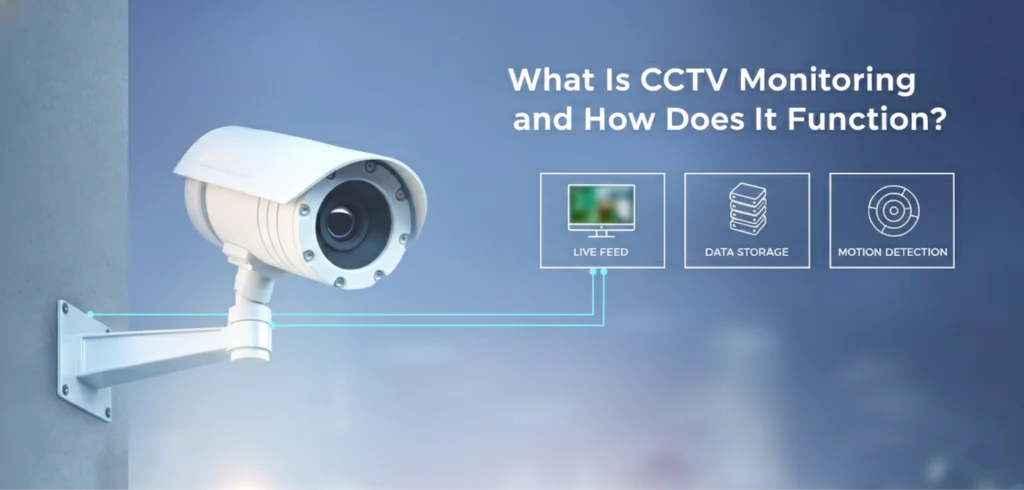
CCTV monitoring is an important element of preventing any risks and offering peace of mind in the present-day world, where the issue of safety is one of the primary concerns of houses, companies, and areas. Closed-Circuit Television (CCTV) monitoring can be defined as a practice of using cameras to control, monitor, and track the activities within a given area as a security and surveillance measure. CCTV footage is sent to a small number of monitors, unlike the open broadcasting systems, hence it is a controlled and secure solution.
Understanding CCTV Monitoring
CCTV surveillance does not merely involve placing cameras. It entails a total surveillance system in which the cameras are continuously used to record video and monitor it in a video surveillance system. This system can either be accessed during the actual time or can be looked into in the future when the need arises. Their primary aim is to identify suspicious behavior, deter crime, and offer evidence in case an act is done.
The CCTV systems in the contemporary world have become common in residential buildings, offices, retail outlets, warehouses, hospitals, and even in the infrastructure of the people because of their reliability and efficiency.
How CCTV Monitoring Works
The working of a CCTV monitoring system follows a structured process:
1. Video Capture
The CCTV cameras are installed at strategic points to be able to cover important areas. They are motion-detecting cameras or video recorders, depending on the configuration of the system.
2. Data Transmission
The captured video is sent by wired (either coaxial or Ethernet cables) or wireless (Wi-Fi) means. In high-end systems, video information is transmitted to cloud servers via the internet.
3. Recording and Storage
Video clips are captured on Digital Video Recorders (DVRs), Network Video Recorders (NRVs), or cloud-based. Storage time varies according to camera resolution, storage capacity, and recording settings.
4. Monitoring and Access
Live footage or recorded videos may be viewed in monitors, computers, or mobile devices by authorized users. Most systems are remote access, and this allows the user to monitor his or her property anywhere.
5. Alerts and Analysis
Smart CCTV systems are motion sensors and AI-based analytics that identify any unusual activity. Upon activation, alerts can be received immediately through mobile applications or email and, therefore, easily acted upon.
Types of CCTV Monitoring
- Live Monitoring: Immediate observation by the security staff or the owner of the home.
- Recorded Surveillance: Replaying recorded footage following an incident.
- Remote Monitoring: Accessing the system from any given place through the internet.
- Smart Monitoring: Threat-detection smart systems with reduced false-detection.
Benefits of CCTV Monitoring
CCTV surveillance has several benefits:
- Creates a great disincentive to stealing and vandalism.
- Increases general security and awareness.
- Gives credible information in investigations.
- It allows 24/7 monitoring without human effort.
- Assists with the control of the employees and operations.
Where CCTV Monitoring Is Commonly Used
CCTV surveillance has become popular in:
- Homes and gated communities
- Shopping centers and supermarkets.
- Offices and business premises.
- Factories and warehouses
- Schools, hospitals, and social locations.
Final Thoughts
The CCTV surveillance has become an intelligent and very crucial security tool. Modern systems are very different and much more than a basic video recording because it has advanced features such as remote access, cloud storage, and smart notifications. CCTV monitoring can be used at home or in business to ensure a safer environment, as it is always under surveillance and can provide an opportunity to respond promptly at the time when it is needed most.e, and intelligent alerts, modern systems offer much more than basic video recording. Whether for a home or a business, CCTV monitoring helps create a safer environment by keeping a constant watch and enabling quick response when it matters most.