
What Are the Types of Cameras? Which Camera Will Be Useful for You?
Security cameras no longer represent simple devices of recording but rather have become intelligent surveillance systems that are actively used to guard homes, businesses, and even the street. As security issues grow and smarter technologies are entering the market, it is no longer a matter of finding a camera that can be installed, but rather of finding a solution that meets your needs in regards to the environment, purpose of use, and what you will need in the future security-wise. Knowing the various kinds of cameras and the way they operate will be useful in making a long-term decision that will provide reliability, clarity, and tranquility.
When users search for something such as types of security cameras, the best CCTV camera to use at home, or what is the best camera to use in business, the users are literally searching to find clarity. These are the types of cameras that are described in a paragraph-by-paragraph format to enable you to make the appropriate choice of a camera with a lot of confidence.
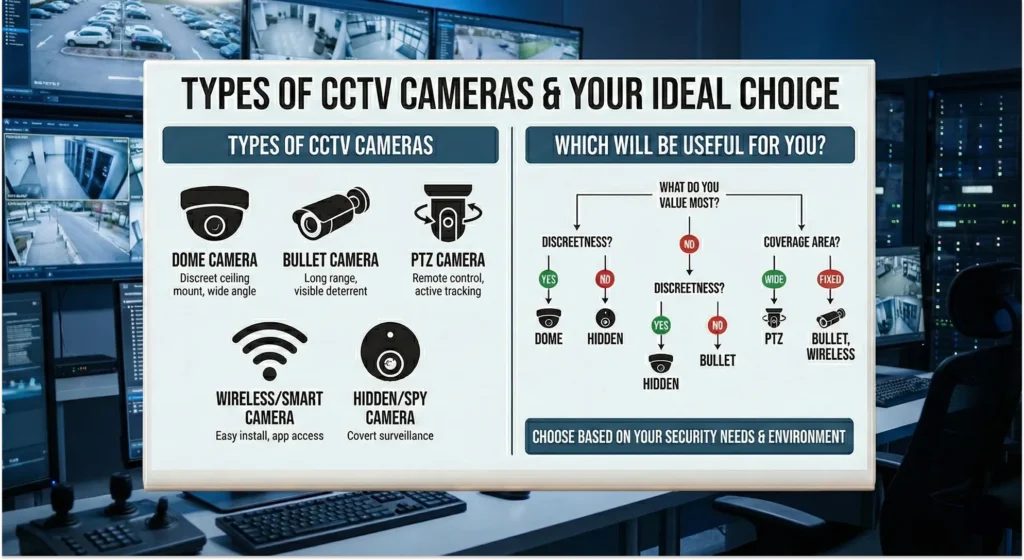
Dome Cameras – Subtle Yet Effective Indoor Surveillance
One of the most common surveillance cameras used is the dome camera, particularly indoors. They are small and shaped in a dome form that does not stick out of the ceiling, hence they suit well in areas that value appearance and privacy. Among the greatest benefits of dome cameras, it is hard to notice where the camera is facing, which creates the aspect of uncertainty to the intruders, and decreases the chances of being caught. These types of cameras are normally wide-angle, and hence are ideal when one wants to watch over a wide area like an office, grocery store, an apartment, or a check-in area. Dome cameras have the advantage of offering some coverage, longevity, and professionalism to users who are in need of indoor security cameras that they can rely on.
Bullet Cameras – Strong Outdoor Security with Clear Visibility
Bullet cameras are used in long-distance surveillance and are often used outdoors. They are cylindrically shaped and can be used to target a particular place, which in this case may be gates, driveways, parking lots, and compound walls. Since bullet cameras are visible, they are a great deterrent to potential intruders. The majority of the bullet cameras are rated as being weatherproof and have the infrared night vision feature, which enables them to remain active even during rain, dust, and low light. When you need outdoor CCTV cameras, and you have a good range of visibility and want to keep all your attention on one thing, the bullet cameras are a reliable solution because they will provide both prevention and evidence.
PTZ Cameras – Intelligent Monitoring for Large Areas
PTZ (pan-tilt-zoom) cameras are designed in locations where it is needed to perform dynamic surveillance. Unlike the fixed cameras, the PTZ cameras can be moved horizontally, vertically, as well as zoom in on a given object or individual. This renders them very efficient in policing a wide region with fewer cameras. They are mostly applied in manufacturing plants, college campuses, stadiums, and transportation centers that demand security guards to have real-time control. The users who would wish to use PTZ cameras are in need of sophisticated surveillance cameras, which are capable of changing with the circumstances, and offering close-up shots when necessary.
Wireless Cameras – Flexible and Easy-to-Install Security
The use of wireless cameras is becoming popular because they are easy to install and convenient. These cameras have Wi-Fi connection, which eliminates the use of extensive wiring and is suitable in households, rented apartments, and small offices. Wireless cameras enable the user to view live video remotely using mobile applications, thus making them a favorite among individuals who would wish to have access to security even when traveling. To the homeowner who wants WiFi security cameras in the house, the wireless cameras provide flexibility and easy installation with contemporary features without a complicated infrastructure.
IP Cameras – Smart, High-Resolution Surveillance Solutions
The new generation of surveillance technology is the IP (Internet Protocol) cameras. These cameras are able to capture video on a network in a digital form and which has better image quality than traditional systems. IP cameras have Full HD and 4K resolution, and they are suitable in cases when facial recognition, identification of number plates, and detailed shots are essential. They are also compatible with smart security systems, and they have features such as motion detection, alerts, and remote access. IP cameras are one of the most powerful cameras for users who want smart CCTV cameras that are scalable and future-ready.
Analog Cameras – Reliable and Budget-Friendly Monitoring
Traditional CCTV cameras are still in use today and are mainly used in simple security requirements. They are linked to DVR systems, and they are frequently selected because of their low cost and ease of use. Although they might not be advanced in terms of analytics and ultra-high resolution, analog cameras are stable in their performance and could be used in small shops, minimal home security, and low-budget installations. Analog cameras are still viable and useful to users who need a CCTV camera set that meets their financial needs.
Night Vision and Infrared Cameras – Security That Never Sleeps
Round-the-clock security will require night vision cameras. These cameras work under infrared technology, thus being able to record clear images even when total darkness. Night vision cameras are installed either inside or outside to keep the security coverage on even after the sun sets. They are particularly applicable in the security of the perimeter, parking lots and warehouses where it is not as visible at night. The cameras with high infrared capacity are required in case your need is 24/7 security surveillance.
Which Camera Will Be Useful for You?
The ideal camera to buy will be based on various factors, like the location, the coverage area, the lighting conditions, and the budget. The dome cameras would be a good option in the case of indoor areas where design is a consideration. Bullet cameras are better in open spaces where there is a need to have a longer distance and a visible type of deterrence. PTZ cameras can be used in large premises because they have a high degree of flexibility in motion, whereas wireless or IP cameras are conveniently used in homes and small offices because of the smart capabilities of the cameras. Using budget-friendly solutions, users are free to choose analog systems, whereas long-term, intelligent security should be considered IP-based solutions.
Final Thoughts
Selecting an appropriate security camera does not mean that you should get the most expensive one, but one that best fits your needs today, and is also flexible enough to meet your needs in the future. With knowledge of the various types of cameras and how they can be used in real life, you can create a surveillance system that gives clarity, control, and confidence. It can be a house, office, warehouse, or shop: the appropriate camera will guarantee safety, responsibility, and tranquility.