
NVR vs DVR: Key Differences Explained
1. Introduction: Why the NVR vs DVR Decision Matters
When selecting the appropriate surveillance, it is not only about your cameras but also the way your cameras capture, store, and distribute the image you use to keep yourself safe. Numerous individuals ambiguously decide whether to install either an NVR or DVR system, which is measuringly so. They are both video recording, both provide security, but they are different in the core of the technology. Learning about such differences is what will make you pick the system that will address your needs in terms of security now and will remain trustworthy over the upcoming years.
2. What Is a DVR System?
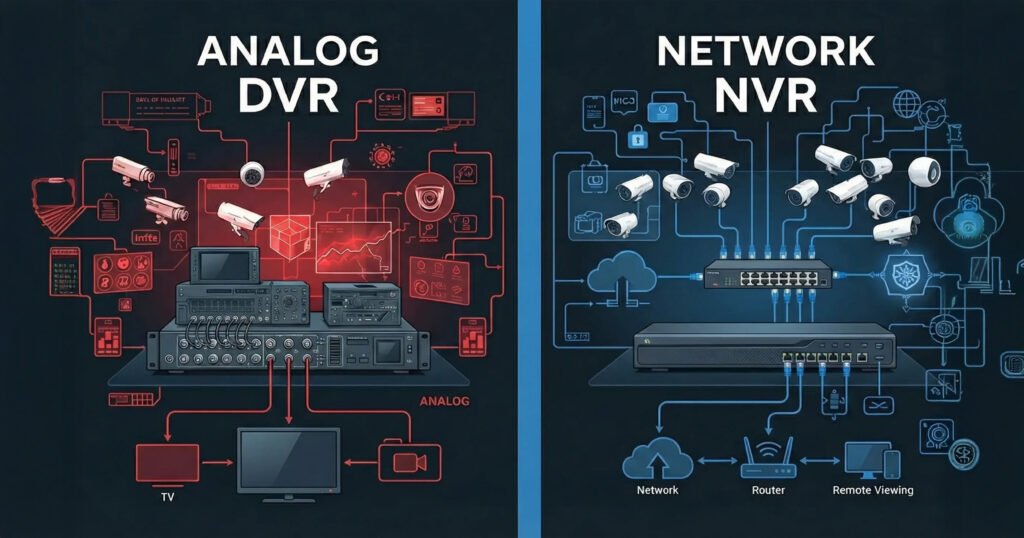
The conventional security recording device that was employed in analog CCTV systems is known as a DVR (Digital Video Recorder). It operates with analog cameras, which transmit raw video signals to the DVR using coaxial cables. Then the video is processed on the DVR, converted, and stored. Although DVR systems are cheap and very popular, they greatly rely on the quality of cables, distance, and camera restrictions. They fit well in simpler and low-end constructions where the clarity of the image in high definition is not paramount.
3. What Is an NVR System?
NVR (Network Video Recorder) is a modern and digital surveillance system that is IP camera-based. As opposed to DVR, the NVR does not process analog signals, but the video is captured and encoded by IP cameras themselves and then sent across the network. This leads to better and clearer recording and a better recording system. NVR systems are also compatible with intelligent capabilities and can easily be configured to have motion detection areas, artificial intelligence, and remote viewing.
4. How DVR Systems Work
DVR technology is analog. The cameras are linked to the DVR by coaxial cables, which carry raw video signals. These signals are processed, and the footage is compressed and stored on a hard drive by the DVR. This implies that a good deal of heavy work is done by the DVR. The most popular are distance limitations, cable interference, and low resolution. It is a little more complicated because each camera needs its own power cables to be installed.
5. How NVR Systems Work
NVR systems are all digital. IP cameras transmit the footage using the Ethernet cable, and the video is already coded before it is transmitted to the NVR. This enables easier playback, better frame rates, and better clarity even over long distances. Power-over-Ethernet (PoE) is a type of cable that supplies power and data and eliminates clutter, and makes installation easier. NVR systems are also easy to scale, which is appropriate when one wants to expand their business or property.
6. Video Quality Differences
NVR systems have an advantage in video clarity. Since the video is already digital in the IP cameras, the NVR footage is sharp, high-definition, and stable. Cameras are up to 4K and higher.
However, DVR footage relies on the signal quality of analog. The quality of the video is getting better, yet it is not as good as the IP-based NVR systems.In simple terms:
⭐ NVR = higher clarity, more detail
⭐ DVR = adequate for basic monitoring
7. Installation & Cabling
DVR can only be connected by using coaxial cables and power lines per camera. This complicates the process of installation and is not as flexible with large buildings.
NVR systems are built with Ethernet cables, which are very lightweight, easily handled, and can accommodate power and data using PoE. This brings in less messy arrangements, fewer cables, and fewer troubleshooting.
NVR is the clear winner in the case of scalability if you want to increase the number of cameras in the network.
8. Smart Features & Technology
NNVR systems allow advanced features like:
- AI motion detection
- Line crossing alerts
- Human/vehicle recognition
- Smart playback
- Remote monitoring
- Cloud integration
DVR systems offer basic recording and playback but fewer intelligent capabilities because analog cameras don’t support digital analytics.
If you want automation and smart security, NVR is the future-ready option.
9. Cost Comparison
DVRs are usually cheaper on the initial investment due to the lower cost of analog cameras. They suit small shops, simple home applications, and installations that are cost-conscious.
NVR systems are initially more expensive but are more robust, have better resolution, and updated features- they are an expensive investment in the long term, where serious security considerations are applied.
It usually comes to this decision:
Do you like it cheap, or do you like high performance and durability?
10. Final Verdict: Which One Should You Choose?
Both systems serve different needs.
Both systems serve different needs.
Choose DVR if:
- You want a budget-friendly system
- Your property already has coaxial cables
- You only need basic surveillance
Choose NVR if:
- You want high-definition clarity
- You need advanced smart features
- You prefer an easier installation and scalability
- You want a modern, future-proof system
In most cases, NVR stands out for its superior performance, flexibility, and long-term value. DVR still works for simple setups, but NVR has become the preferred choice for modern homes and businesses that don’t want to compromise on quality or intelligence.