
How to Choose the Right Home Security System in India — 2026 Buyer’s Guide
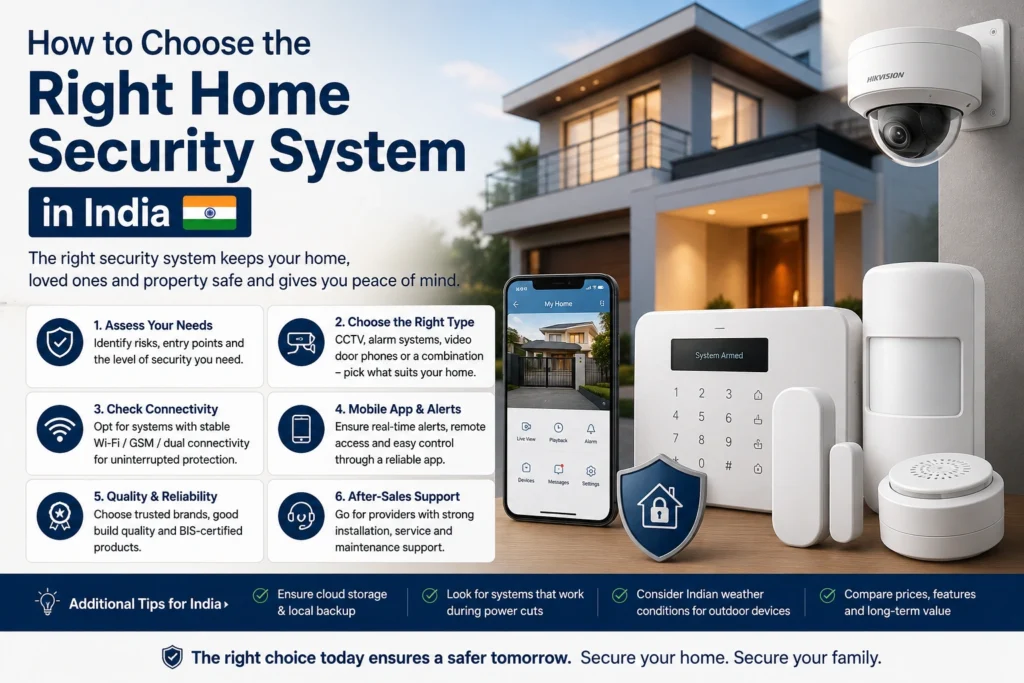
Home security isn’t just a privilege in India anymore. Driven by increasing urbanization, high property investment, and heightened consciousness about safety, property owners are increasingly searching for smarter and more effective ways of securing their families and property. From an apartment in Bangalore, to a villa in Hyderabad, to an independent house in Chennai, to a farmhouse in the vicinity of any major city, one of the major purchasing decisions a homeowner must make is selecting a security system.
However, with a number of home security systems in the market, a simple search query online will fetch you a plethora of security cameras, smart alarms, video doorbells, sensors, and integrated home security systems. Whilst an advantage to most of the customers in terms of variety, this tends to confuse many homeowners.
In this exhaustive 2026 buyer’s guide, learn how to select a home security system for India for your specific property type, budget, and security needs.
Why Home Security Matters More Than Ever
In recent times, residential construction has accelerated considerably. Along with it, the concerns of homeowners toward breaking into houses, forced entry, stealing packages, and the safety of their family during their absence have significantly increased.
A modern security system is far beyond a video recorder. The advanced smart security systems today can:
- Notify intrusion in real time
- Send an alert on your mobile instantly
- Be monitored from a distance
- Collect video evidence when an incident happens
- Work seamlessly with smart devices in your home
- Help in safeguarding children and aged relatives
- Provide monitoring of entrances and visitors
The appropriate system allows you to feel completely at ease while you’re at work, overseas, or asleep during the night.
Start by Assessing Your Property Type
When selecting a home security system, the first step is determining the type of property you intend to secure.
Apartment Security Needs
Apartment owners typically need the following security features:
- Video door phones
- Smart door locks
- Internal security cameras
- Motion sensors
- Video doorbells
Because apartment communities typically have gates and guards, their security needs tend to revolve around the main entrance and internal areas of the property.
Independent Houses
Because of the increased number of access points for an independent house, security is more of an issue for this type of property.
Homeowners should have the following on their wish list for home security systems:
- External CCTV cameras
- Motion detection devices
- Sensors for each window and door
- Smart alarms
- Video intercom systems
Properties of this kind usually require perimeter security in conjunction with internal security monitoring.
Villas and Estates
The security system in a villa needs to be thorough. Owners will typically invest in:
- Several CCTV cameras
- Access control system
- Various intrusion sensors
- Remote monitoring services
- Integration with smart gates
A villa’s large area usually benefits from an installed security system rather than individual gadgets.
Get familiar with security device types
A common error many people make is buying the equipment and then learning what it actually is.
Let’s break down what the primary systems of a modern security system consist of:
CCTV Security Cameras
CCTV cameras are the most basic security system component.
Factors to consider when buying a CCTV system:
- Resolution quality-(preferring 2MP and above).
- Night vision.
- Outdoor resistance for exterior cameras.
- Wider viewing angle for surveillance.
- Mobile remote access.
The higher the resolution, the clearer the images will appear, which could make the identification of a suspect, vehicle or incident easier.
Video Door Phones
Video door phones offer you the ability to identify your visitors before allowing entry and then even communicate with them prior to letting them in.
A few benefits of having them include:
- Identification of unknown visitors.
- Enhanced home security.
- Remote communication ability.
- Convenience.
These are beneficial for apartments and gated communities.
Smart Door Locks
Traditional keys have now turned into an item of the past, with the evolution of smarter access.
Some smart lock features to consider:
- PIN entry.
- Fingerprint scanning.
- Mobile application control.
- Time-sensitive visitor codes.
- Access logs.
Motion Sensors
Motion sensors are designed to alert you whenever someone enters the predetermined surveillance area.
Some useful areas where motion sensors are effective:
- Doorways.
- Hallways.
- Garages.
- Yard boundaries.
Motion detection offers a prompt warning.
Alarm Systems
An alarm system is a direct response system to potential threats of unauthorized entry.
Features of a modern-day alarm system include:
- Alarms triggering.
- Smartphone notifications.
- Camera integration.
- Connection to monitoring centers.
Even just a visible alarm system can serve as a deterrent.
Wired vs. Wireless Security Systems: Which is right for you?
Probably one of the most frequently asked questions of any homeowner. Wired or wireless systems are both common.
Wired Security Systems
Pros:
Good, steady connection
Reliable operation
Less signal interference
Better for large homes/properties
Cons:
Harder to install
More expensive to install
Not very portable
Wireless Security Systems
Pros:
Easy installation
Can be placed anywhere
Quick to install
Requires little wiring
Cons:
Uses Wi-Fi connection
Requires batteries to be charged or replaced
Susceptible to interference
For apartments and new modern Indian houses, the wireless system should perform well enough. Large villas may need wired systems or a hybrid wired-wireless system.
Scrutinise mobile app functionalities thoroughly
A modern security system in 2026 hinges more on the mobile application and not hardware, which we’ve realised, and many homeowners seem to be solely fixated with the hardware components, and less on the software experience. Before signing on the dotted line, ensure the system comes with the following:
- Live video stream
- Instant alerts and notifications
- Event footage storage
- Remote footage viewing and playback
- User profiles
- Cloud connectivity
- Two-way communication
A frustrating user interface will just nullify the best of security features.
Factors concerning the internet and power backup should not be overlooked
One cannot deny that India is a country with infrastructural problems to deal with. Power cut-outs and lack of internet connectivity might be a hindrance to the functioning of security systems. When you make the purchase, make sure the system at least supports:
- Local data backup
- UPS compatibility
- Battery-operated devices
- Offline recording
- Automatic start-up upon power return
Storage Solutions: Cloud vs Local Recording
The security camera footage you record is useless to you if you can’t access it when you need it.
For the homeowner, you have two options in storing your recordings: cloud storage or local storage.
Cloud Storage
Pros:
Remote access
Automatic backups
Ease of retrieving data
Reduced risk of losing recordings
Cons:
Monthly costs for storage
Reliance on the Internet
Local Storage
Pros:
No monthly costs
Faster access to data
Full data ownership
Cons:
Risk of physical damage to the device
Limited storage capacity
Assess Installation and After-Sales Service
When buying a security system, one of the areas often overlooked is after-sales service.
High-quality equipment can still become an issue without proper technical support. Before you purchase, determine the following:
- Is professional installation available?
- How long is the warranty?
- How quickly will technicians respond?
- Are spare parts available locally?
- Can technical support be provided remotely?
- Often, excellent support will outweigh minor differences in hardware.
What to avoid when buying
Most people spend too much on devices and end up with systems not best suited for them. Many get carried away by advertisements and overlook practical needs. Steer clear from these common buying mistakes:
Focusing on just the price, Cheap might skip out on features that matter.
Installing the wrong number of cameras-Blind spots would render the system quite useless in parts.
Forgetting future upgrades, the systems may become inadequate later.
Not caring about cybersecurity- a weak link that is all it takes.
Not testing mobile accessibility-The app is likely useless if it performs poorly.
How much can I spend in 2026?
Depending on your needs, space, and security systems, prices are prone to vary widely. A general breakdown of spending is:
Apartment
₹10,000 – ₹35,000
(Including smart doorbell, indoor camera, smart lock)
Independent House
₹30,000 – ₹1,00,000
(Including multiple cameras, sensors, and an alarm system)
Villas & premium homes
₹1,00,000+
(Including surveillance system, access control, smart home integration)
Instead of considering the initial amount alone, it’s crucial to look for reliability and long-term serviceability.
Conclusion
Finding the correct home security system in India is not just about purchasing some cameras for your home. A smart security solution for a home must be tailored to its individual characteristics based on the size of the property, neighborhood, family needs, internet connection reliability, and the potential to expand the system in the future.
An optimal home security system should offer real-time surveillance, timely and reliable notification, secure data and excellent post-sales service. By evaluating each home carefully and analyzing products thoughtfully, you are more likely to buy a security solution that will protect your home for years to come and also offer you a greater sense of comfort and safety.
By the time 2026 arrives, home security systems and the technology behind them will only become even more available, cost-effective, and efficient. Choosing the security system that offers adequate protection for your home will ensure peace of mind for you and your loved ones.