
7 Essential Types of Physical Access Control Explained
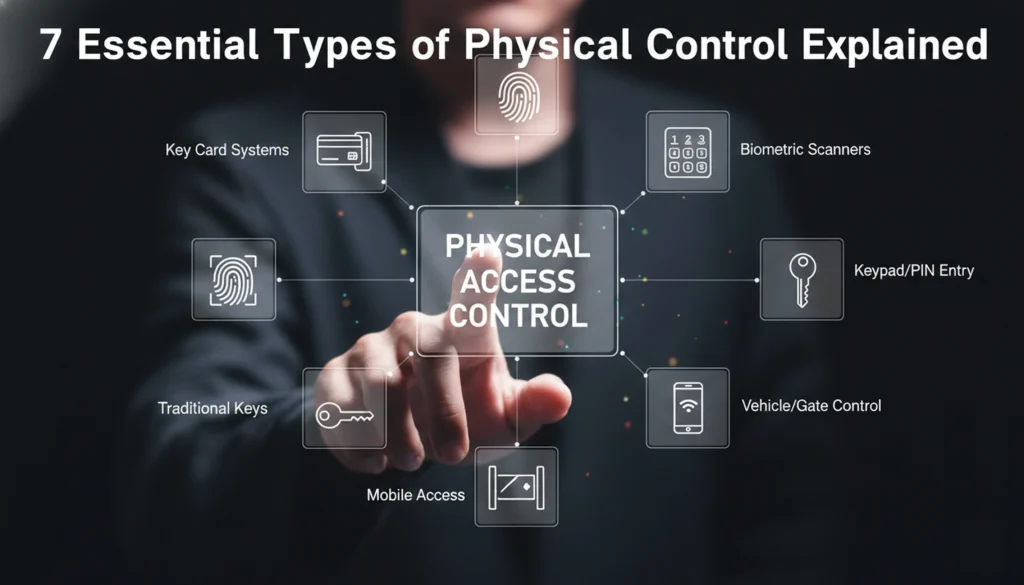
Physical access control is a cornerstone of contemporary security systems. It defines who may enter, leave, or move in a physical space, and it assists organizations in securing people and assets as well as confidential information. Physical access control has been revamped to address the growing security needs of homes, commercial, and industrial settings, with traditional locks, up to sophisticated biometric systems.
Knowledge of the various forms of physical access control is necessary to select the appropriate security measure and ensure adherence to safety measures.
1. Mechanical Lock and Key Systems
The oldest type of physical access control is the mechanical lock. They make use of physical keys in order to open or lock doors, cabinets, or guarded areas. Simple and cheap, these systems have a limited level of control since a lost or duplicated key may lead to a security breach.
Mechanical locks are usually applied to low-risk areas or the upper level of protection.
2. Keypad-Based Access Control
Keypad systems also have an entry method of a numeric code/ PIN. They also require physical keys to be eliminated and enable an administrator to change access codes without any difficulties.
Nevertheless, exposed or shared codes may lower the security level, and keypad access is preferable in a controlled setting or with some other forms of authentication.
3. Card-Based Access Control Systems
Card-based systems are systems that are based on access cards, key fobs or smart cards to admit entry. The user swipes his or her card before authorization is granted and the door is unlocked.
Better tracking and access control can be achieved through these systems over mechanical locks since lost cards can be switched off without altering hardware.
4. Biometric Access Control
Biometric access control involves the physical features that are unique, including fingerprints, facial features, iris scan, or palm pattern. Biometric data is specific to everyone, and therefore, this form of access control is very secure.
Biometric systems can be found in high-security places, offices of corporations, data storage centers, and other places where identification is paramount.
5. Mobile-Based Access Control
Mobile access control enables users to be able to unlock the doors via smartphones via secure applications, Bluetooth, NFC or cloud-based. The solution can be scaled and controlled remotely since access permissions can be managed.
Such a kind of access control is gaining popularity within the current working environment, as well as smart buildings, as it is convenient and easily managed.
6. Token-Based Access Control
The token-based systems are based on the use of physical tokens like USB keys or electronic tags in order to identify a user. These cards hold encrypted entry credentials and require physical presence to be accessed.
Even though it is safe, token systems that are based on the token are also supposed to be managed closely in order to avoid loss or misuse.
7. Multi-Factor Physical Access Control
Multi-factor access control entails the use of two or more authentication modes, including card and PIN or biometrics and mobile. This multi-tiered solution helps tremendously minimize the possibility of unauthorized access.
Multi-factor systems are usually deployed in the context of facilities having strict security requirements, including financial institutions, laboratories, and critical infrastructure facilities.
Why Physical Access Control Matters
- Physical access control is effective in assisting:
- Prevent unauthorized entry
- Secure human beings, property, and information.
- Enhance responsibility and surveillance.
- Safety and security compliance Support.
- Increase the general control of operations.
Final Thoughts
There is no physical access control that fits all. All types have a particular use depending on the security requirements, risk level, and operational requirements. Knowing these seven basic physical access control types, organizations and property owners can develop a security framework that is easy-to-use, convenient, and sustainable in the long term.
The proper choice of access control mitigation is the first step in the right direction in the development of more secure and safer environments.