
Fire Safety Systems: Comparing Automatic and Manual Fire Alarm Solutions
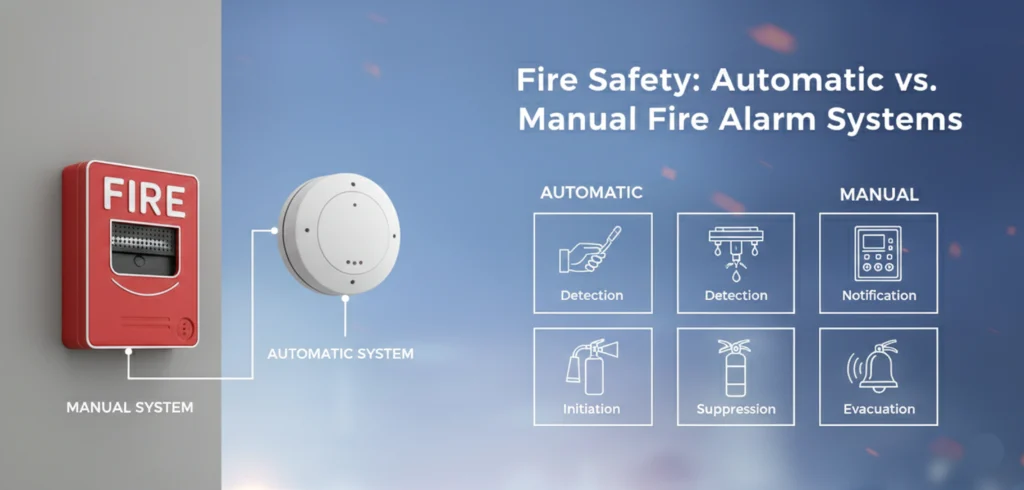
Fire safety systems will form an important element of life, property, and continuity protection. In residential structures, commercial premises, or industrial establishments, the early detection of fire and prompt messages can go a long way to minimize damage and loss of life. Two of the most popular options of fire safety solutions include the automatic fire alarm systems and the manual fire alarm systems, each with its unique purpose in the overall fire protection plan.
It is important to understand that each of these systems operates and is different to ensure that property owners and safety managers make well-informed decisions that are in compliance with regulatory guidelines and the safety requirements in practice.
Understanding Fire Safety Systems
The fire safety systems are meant to identify hazards associated with fire, like smoke, heat, or flames, and warn the occupants so that prompt action may be undertaken. The emergency response teams can also be aided through these systems, as they give early warnings to enhance the rate of evacuation and control of fire.
An effective fire safety system should be designed in such a way that it includes methods of detection and alerting as well as responding, and this should be ready around the clock.
What Are Automatic Fire Alarm Systems?
An automatic fire alarm system is a system that is meant to identify fire conditions automatically without any human intervention. They have sensors (smoke detectors, heat detectors or flame detectors) that detect the signs of fire in its initial stages.
Having received a notification of a threat, the system reacts automatically to it, sending out an alarm, turning on warning signals, and even providing a direct connection to the emergency management system. Such a quick and automatic response is particularly useful when the fire can begin without being noticed, including storage rooms, server rooms, or the absence of people.
Key Benefits of Automatic Fire Alarm Systems
- Continuous, 24/7 monitoring
- Reduced response time and quicker detection.
- Less reliance on human observation.
- Apposite in a large and high-risk environment.
- Helps are in line with fire safety requirements today.
What Are Manual Fire Alarm Systems?
Manual fire alarm systems are also based on the involvement of a human being to effect an alert. These systems usually incorporate manual call points or break-glass units, which are located at the available points in a building.
When an individual observes fire, smoke, or danger, he or she works the alarm to alert others after it has changed to manual. Manual systems serve as a secondary level of safety measure, or more frequently in smaller buildings, where people will never miss their presence.
Key Benefits of Manual Fire Alarm Systems
- Basic and inexpensive installation.
- Easy to operate and maintain
- It can be utilized as an addition to automatic systems.
- Works in places where people are always present.
Automatic vs Manual Fire Alarm Systems: A Clear Comparison
The automatic fire alarm systems are faster and more efficient in detecting fire since the human eye is not available to observe the early signs of fire. Manual systems, on the other hand, rely on the human consciousness and reaction speed, which can slow down the alerts in the case of an emergency.
Although the automatic systems offer greater safety cover, the manual systems continue to hold significance because they serve as the supplementary solution to the first category in that the alerts can be drawn at the moment the people are close.
In most of the contemporary constructions, both systems have been combined to form a stratified fire protection technique to ensure maximum security.
Choosing the Right Fire Safety System
The choice of an appropriate fire safety system depends on the building size, the level of occupancy, the risk of fire, the regulations, and the budget. In most cases, commercial and industrial settings demand the use of automatic fire alarm systems because the risk factor is higher and the requirements are also enforced, whereas the smaller properties may need both in combination.
The system reliability and long-term effectiveness should be ensured by installing it by a professional, periodically testing and maintaining it.
Final Thoughts
Safety of fire systems is not a choice to be made; it is a requirement. Both automatic and manual fire alarm systems play a crucial role in the early detection of fire and emergency response. These systems can save lives and fortunes when selected and properly implemented, since they contribute to safety, risk reduction, and the saving of lives.
Compliance is not the only thing that holds the key to investing in the right fire alarm solution; preparedness, responsibility, and long-term security are also issues of concern.